
- Introduction:
Yoga, an ancient practice originating from India, is much more than physical exercise; it is a holistic discipline that promotes mental, physical, and spiritual well-being. In the context of women’s empowerment, yoga plays a significant role by fostering self-awareness, confidence, and inner strength, which are essential for overcoming societal and personal challenges. The integration of yoga into daily life can lead to profound transformations, empowering women to lead more balanced, healthy, and fulfilling lives.
One of the fundamental ways yoga empowers women is by enhancing self-awareness and self-acceptance. Through practices such as meditation, pranayama (breath control), and asanas (postures), yoga encourages introspection and a deeper connection with one’s inner self. This self-awareness helps women recognize their inherent strengths and capabilities, fostering a sense of confidence and self-worth. When women are in tune with their inner selves, they are better equipped to make informed decisions and stand up for their rights and needs.
The Ancient and medieval status of women in modern Indian society regarding Equality, Education, Marriage and Family life, Race and Gender, Religion and Culture is maintained or deteriorated. The RigVedic Women in India enjoyed a high status in society. The women were provided an opportunity to attain high intellectual and spiritual standards. In Vedic India, women did not enjoy an inferior status; rather, they occupied an honorable place. They had ample rights in the social and religious fields and limited rights in the economic and political fields. They were not treated as inferior or subordinate but equal to men. We have honored our country as our Motherland “Bharat Mata,” and our nationalism has grown up from the seed Mantra “Vande Mataram”.1
Being a traditional patriarchal society, women have been given a secondary status, which is reflected in the economic, social, and political spheres. However, women’s equality and empowerment have always remained a priority area and have been taken utmost care of by stakeholders. The paper critically investigates the Indian status among other countries and tries to find out preparedness to achieve Sustainable Development Goal -5 of the United Nations.2
- Objective:
- To Evaluate Physical Health Benefits and Their Socio-Economic Impacts
- To Assess Mental Health Improvements and Their Effects on Economic Stability
- To Examine the Impact of Yoga on Women’s Reproductive Health and Its Economic Implications
- To Explore Yoga’s Contribution to Leadership and Community Engagement
- To Measure the Impact of Yoga on Women’s Financial Independence
- Research Methodology:
The method used in this paper is the descriptive-evaluative method. The study is mainly review-based. It is based on only secondary sources of data, i.e. books, journals, papers, articles, and the internet.
- Women’s Empowerment:
Women’s empowerment is the key to strengthening their participation in the decision- making which is the most important key to socio-economic development. India is a developing country, and its economic status is also very bad because of the male-dominated society. Women constitute roughly 50% of the nation’s population, and a majority of them remain economically dependent, without employment.3
Women’s empowerment is an important goal in achieving sustainable development worldwide. Offering access to microfinance services to women is one way to increase women’s empowerment. However, empirical evidence provides mixed results with respect to its effectiveness.4
Empowerment of women is essentially the process of upliftment of the economic, social, and political status of women, the traditionally underprivileged ones, in society. It is the process of guarding them against all forms of violence. Women’s empowerment involves the building up of a society, a political environment, wherein women can breathe without the fear of oppression, exploitation, apprehension, discrimination, and the general feeling of persecution that goes with being a woman in a traditionally male-dominated structure.5
- What is Yoga?
Yoga is an ancient practice that originated in India over 5,000 years ago, encompassing physical, mental, and spiritual dimensions. It involves a combination of physical postures (asanas), breath control (pranayama), meditation (dhyana), and ethical principles (yamas and niyamas). The term “yoga” comes from the Sanskrit word “yuj,” meaning to yoke or unite, symbolizing the integration of body, mind, and spirit.
Physically, yoga enhances flexibility, strength, and balance through various postures. Mentally, it reduces stress, anxiety, and depression while improving focus and emotional stability through mindfulness and meditation. Spiritually, yoga fosters a deeper connection with oneself and promotes inner peace and awareness.
There are various styles of yoga, each with unique focuses, such as Hatha, Vinyasa, Ashtanga, and Kundalini. Hatha emphasizes physical postures and breath control, while Vinyasa involves dynamic flow sequences. Ashtanga follows a set series of poses, and Kundalini focuses on awakening spiritual energy.
Overall, yoga promotes holistic well-being, encouraging a balanced lifestyle and enhancing overall quality of life. Its comprehensive approach makes it a powerful tool for personal growth and health, suitable for people of all ages and fitness levels.
- The Relation between Yoga and Women’s Health:
Yoga has a profound impact on women’s health, offering a holistic approach to physical, mental, and emotional well-being. This relationship is multifaceted, addressing specific health concerns and promoting overall wellness.
Physical Health:
- Yoga poses like Supta Baddha Konasana (Reclining Bound Angle Pose) and Setu Bandhasana (Bridge Pose) help alleviate menstrual discomfort, regulate menstrual cycles, and reduce symptoms of PMS.
- Yoga can improve reproductive health and enhance fertility by reducing stress and promoting hormonal balance. Prenatal yoga supports a healthy pregnancy, helping manage symptoms such as back pain and promoting relaxation and strength for childbirth.
- Yoga can regulate endocrine function, which is crucial for maintaining hormonal balance. Practices such as restorative yoga and specific poses like Sarvangasana (Shoulder Stand) support thyroid function and overall hormonal health.
- Weight-bearing yoga poses like Virabhadrasana (Warrior Pose) and Trikonasana (Triangle Pose) strengthen bones and reduce the risk of osteoporosis, a common concern for women, especially post-menopause.
Mental Health:
- Yoga reduces stress and anxiety through relaxation techniques, breath control, and meditation. Practices like Savasana (Corpse Pose) and Yoga Nidra (Yogic Sleep) promote deep relaxation and reduce cortisol levels.
- Regular yoga practice fosters emotional stability and resilience. Techniques like pranayama (breath control) and mindfulness meditation improve emotional regulation, helping women manage stress and emotional challenges more effectively.
Emotional and Psychological Well-being:
- Yoga encourages self-awareness and self-acceptance, promoting a positive body image and boosting self-esteem. This is particularly important for women who often face societal pressures regarding physical appearance.
- Studies have shown that yoga can be effective in reducing symptoms of depression and anxiety. The practice enhances mood through the release of endorphins and promotes a sense of calm and well-being.
Community and Social Support:
- Yoga classes and workshops provide a supportive community environment. Women can connect, share experiences, and support each other, fostering a sense of belonging and mutual encouragement.
- Yoga promotes leadership and empowerment by building confidence and self-awareness. Women who practice yoga are often more likely to take on leadership roles and advocate for themselves and others.
Integrative Health Approach:
- Yoga integrates physical, mental, and spiritual practices, offering a comprehensive approach to health. This holistic perspective helps women maintain balance in all aspects of their lives.
- Regular yoga practice serves as preventive health care, reducing the risk of chronic illnesses such as heart disease, diabetes, and hypertension. By promoting a healthy lifestyle, yoga helps women maintain long-term health and vitality.
- Benefits of Yoga in Women’s Empowerment:
The Essence of Yoga: Yoga, derived from the Sanskrit word “yuj,” means to unite or integrate. It harmonizes the body, mind, and spirit, promoting a balanced and healthy life. The practice includes various components such as asanas (physical postures), pranayama (breath control), meditation, and ethical principles. These elements collectively enhance physical health, mental clarity, and emotional stability.
Physical Empowerment: One of the most visible benefits of yoga is its impact on physical health. Regular practice of asanas improves flexibility, strength, and balance. For women, these physical benefits are particularly significant. They can help manage various health issues, such as menstrual discomfort, hormonal imbalances, and menopause symptoms.
- Flexibility and Strength: Yoga postures stretch and strengthen muscles, improving overall flexibility and physical endurance. This is crucial for women who juggle multiple roles and responsibilities, requiring sustained energy and stamina.
- Health Management: Specific yoga postures like Supta Baddha Konasana (Reclining Bound Angle Pose) and Setu Bandhasana (Bridge Pose) can alleviate menstrual pain and balance hormonal fluctuations. Practices such as these empower women to take control of their health and well-being.
- Reproductive Health: Yoga’s gentle, non-invasive approach can enhance reproductive health. Poses like Bhujangasana (Cobra Pose) and Baddha Konasana (Bound Angle Pose) improve blood circulation in the pelvic region, supporting reproductive organs and functions.
Mental and Emotional Empowerment: Mental health is a critical aspect of women’s empowerment. Yoga offers tools to manage stress, anxiety, and depression, common issues in the fast-paced, high-pressure environments many women navigate daily.
- Stress Reduction: Yoga’s emphasis on mindfulness and relaxation techniques, such as deep breathing and meditation, helps lower cortisol levels, the body’s primary stress hormone. Practices like Savasana (Corpse Pose) and Yoga Nidra (Yogic Sleep) promote deep relaxation, reducing stress and enhancing mental clarity.
- Emotional Resilience: Through regular practice, yoga fosters emotional resilience. It encourages a calm, focused mind, enabling women to handle challenges and adversities with greater ease. Techniques like pranayama and meditation improve emotional regulation, helping women respond rather than react to stressful situations.
- Self-Awareness and Acceptance: Yoga cultivates a deep sense of self-awareness and acceptance. By encouraging introspection and mindfulness, yoga helps women understand their strengths and limitations, fostering a positive self-image and confidence. This self-knowledge is empowering, enabling women to make informed decisions and pursue their goals with conviction.
Spiritual Empowerment: Beyond the physical and mental benefits, yoga also offers spiritual growth. It encourages a deeper connection with oneself and the universe, fostering a sense of purpose and fulfillment.
- Inner Peace: Yoga practices like meditation and pranayama enhance inner peace and spiritual well-being. This inner tranquility empowers women to navigate life’s challenges with grace and equanimity.
- Connection and Purpose: Spiritual practices in yoga help women connect with their higher selves and discover a sense of purpose. This connection fosters a profound sense of empowerment, as women align their actions with their deepest values and aspirations.
Social and Community Empowerment: Yoga also plays a crucial role in social and community empowerment. Group yoga classes and workshops create supportive environments where women can connect, share experiences, and support each other.
- Community Building: Yoga fosters a sense of community and belonging. Women practicing yoga together can form strong support networks, encouraging and uplifting each other. This collective strength is empowering, as it provides a sense of solidarity and mutual support.
- Leadership and Advocacy: As women gain confidence and self-awareness through yoga, they are more likely to take on leadership roles and advocate for themselves and others. The principles of yoga, such as ahimsa (non-violence) and satya (truthfulness), inspire women to lead with integrity and compassion, making positive contributions to their communities.
Integrating Yoga into Daily Life: Incorporating yoga into daily life doesn’t require extensive time or resources. Simple practices can be integrated into daily routines, making yoga accessible to all women.
- Morning Routine: Starting the day with a few minutes of yoga can set a positive tone. Practices like Surya Namaskar (Sun Salutation) energize the body and mind, preparing women to face the day with vitality and focus.
- Mindful Breathing: Throughout the day, mindful breathing exercises can help manage stress and maintain emotional balance. Techniques like Anulom Vilom (Alternate Nostril Breathing) can be practiced anytime to calm the mind and center oneself.
- Evening Relaxation: Ending the day with gentle stretches and relaxation poses can promote restful sleep and rejuvenation. Practices like Viparita Karani (Legs-Up-the-Wall Pose) help relax the body and mind, fostering a sense of peace and well-being.
- Women and Skill Development :
The role of women, both directly and indirectly, has always been crucial in economic development and growth. Historically, when opportunities were limited, women were primarily confined to household tasks and raising children. However, with the expansion of education and skill development, women are now making significant strides in balancing both domestic and professional responsibilities. To support this shift, the Government of India has implemented various laws and policies within the constitutional framework to enhance women’s representation in various professions. Despite these advancements, a significant portion of the female workforce in India remains unskilled. Skills serve as a bridge between available jobs and the workforce. Thus, skill development is a vital tool for improving employment and income-earning opportunities for women, as well as for fostering sustainable rural development and livelihoods. Social outcomes are evidenced by indicators such as income inequality and poverty. Employment outcomes are measured by indicators like employment rates, unemployment, out-of-school youth, and earnings.6
The essentials of skill development whereby the execution of such programs alleviates social issues, accomplishes economic growth, uses demographic dividends, and empowers underprivileged sectors on a socio-economic level. Regarding institutional mechanisms, Prime Minister Kaushal Vikas Yojana (PMKVY), the National Skill Development Corporation (NSDC), and the Ministry of Skill Development and Entrepreneurship have produced notable benefits, but not the intended ones. It makes the case that skill development is a crucial prerequisite for technology adoption and women’s empowerment in the nation. India has to fulfill the growing ambitions of its young as it progresses toward becoming a global knowledge economy.7
Skills development is a key to success, which improves productivity, employability, and earning opportunities. It is the bridge between job and workforce. Today, it is considered an important and indispensable tool for women’s empowerment. Indian women face the majority of barriers to accessing skills and productive employment.8
- Social Upliftment:
Social upliftment encompasses efforts to improve the well-being and opportunities of disadvantaged or marginalized groups within society. It involves initiatives aimed at addressing various social issues such as poverty, inequality, discrimination, and lack of access to essential services. These efforts may include educational programs, vocational training, healthcare services, infrastructure development, and economic empowerment initiatives. The goal of social upliftment is to create a more equitable and inclusive society where all individuals have the opportunity to thrive and contribute positively to their communities. It involves empowering individuals and communities to overcome systemic barriers and achieve their full potential, ultimately leading to greater social cohesion and collective progress.
- Economic Growth:
Women in India make up 7.5% of the world’s total population. While specific development indicators show that their quality of life is improving. That is, maternal mortality rates are declining, literacy rates are increasing, and more women are gaining access to healthcare and education. The pace of change is heartbreakingly slow.9
Most women in India rely more on the informal work sector for an income. If women are empowered to do more, the possibility for economic growth will be at large. If the informal sector is involved in many tasks and activities, then there will be more growth. It was proved that female participation in counsels, groups and businesses is seen to be an increase in efficiency. For instance, how an empowered woman can impact a situation monetarily, this was done by fortune 500 companies, “ Those with more women’s in the category of board directors had significantly higher financial returns, including 53% higher returns on equity, 24% higher returns on the sales and 67% higher returns on the invested capital (OECD,2008).” This study shows that there was an impact of women in the overall economic benefits of the company. If this was implemented on the global scale then the women in the formal workforce can increase the economic output of a nation. Thereby the increase in the economic growth of the nation.10
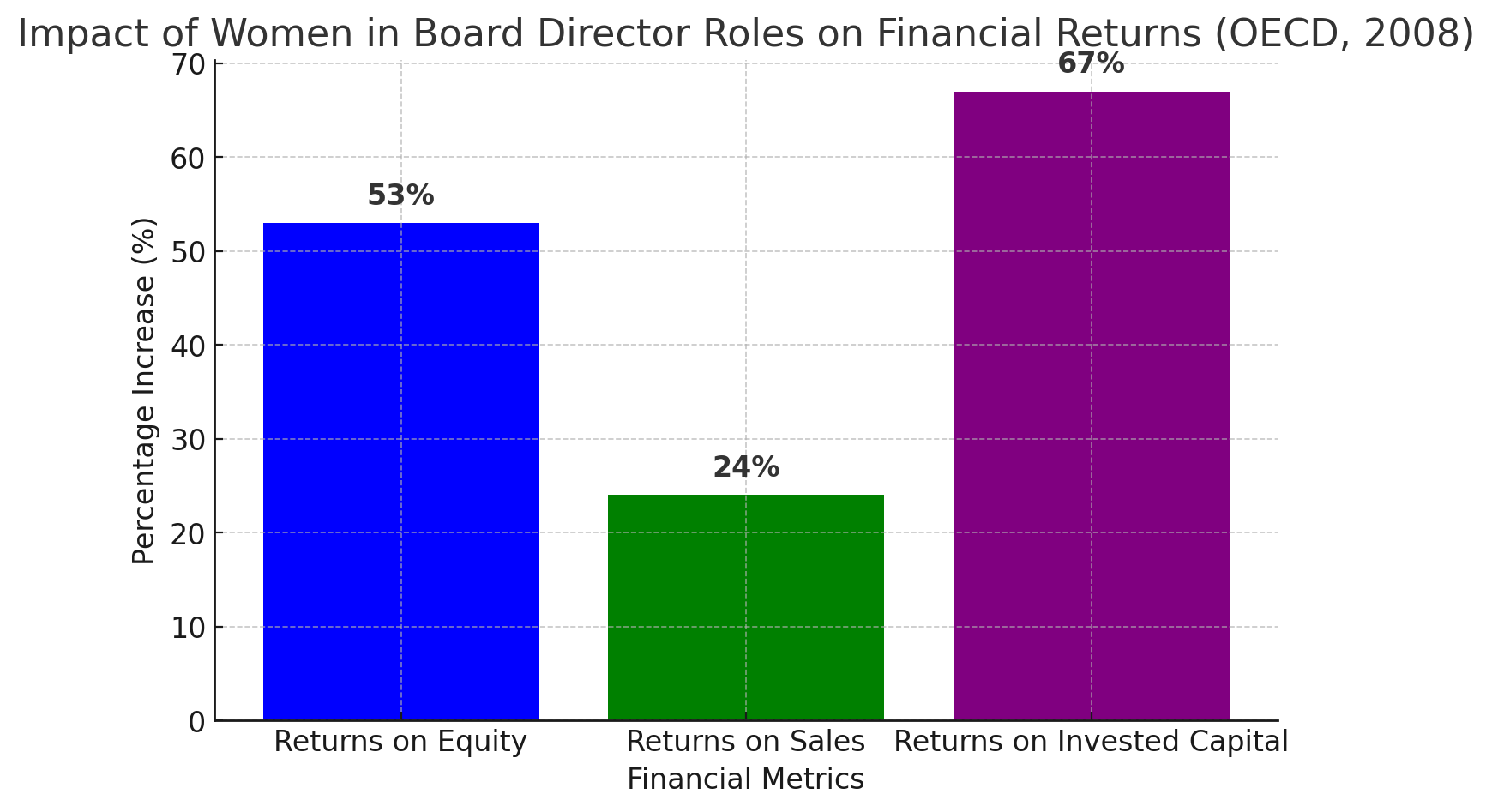
This is a bar chart illustrating the impact of women’s participation in board director roles on financial returns, as cited in the OECD (2008) study. The graph highlights the percentage increase in returns on equity (53%), returns on sales (24%), and returns on invested capital (67%), emphasizing the significant economic contributions of women in leadership positions.
11. Government Efforts and Schemes for Women’s Empowerment through Skill Development
The Government of India has undertaken various initiatives to promote women’s empowerment by fostering skill development and entrepreneurship. Recognizing that economic independence is a crucial aspect of empowerment, these initiatives aim to enhance employability, encourage self-reliance, and provide financial assistance to women across diverse socio-economic backgrounds.
Skill Development and Women Empowerment
Women’s participation in skill development programs is essential for fostering inclusive economic growth. The government has launched several initiatives that equip women with industry-relevant skills, encourage entrepreneurship, and facilitate access to credit and employment opportunities. Programs such as Make in India, Stand-Up India, and Start-Up India provide an enabling environment for women to become self-sufficient contributors to the nation’s economy.
Major Skill Development Schemes for Women’s Empowerment
- National Skill Development Mission (NSDM) – Launched in 2015, this mission provides a unified framework for skill development initiatives across different sectors, with a specific focus on empowering women through tailored training programs.
- Skill India – A flagship initiative that aims to train over 400 million individuals, including women, in various skill sectors by 2022, ensuring employability and self-sufficiency.
- Learn and Earn – Scheme for Minorities – This program is designed to provide skill training and employment opportunities to minority communities, including women, to enhance their financial stability.
- Deen Dayal Upadhyaya Grameen Kaushalya Yojana (DDU-GKY) – Focused on rural skill development, this initiative provides women with industry-relevant training and employment opportunities, particularly in underprivileged areas.
- National Skill Development Corporation (NSDC) – Established as a public-private partnership model, NSDC focuses on vocational training and capacity building, encouraging women’s participation in diverse economic sectors.
- National Skill Development Agency (NSDA) – This agency works towards standardizing and implementing skill development programs while ensuring inclusivity and accessibility for women.
- National Rural Livelihood Mission (NRLM) – By organizing rural women into self-help groups (SHGs), NRLM enhances skill development and provides financial linkages to promote sustainable livelihoods.
- Pradhan Mantri Kaushal Vikas Yojana (PMKVY) – Under this scheme, skill certification programs are conducted to enable youth, particularly women, to gain employable skills in various industries.
- Pradhan Mantri Mudra Yojana (PMMY) – Focused on providing collateral-free loans to small businesses, this initiative facilitates women entrepreneurs in starting and expanding their ventures.
- Make in India – This program encourages domestic manufacturing by providing infrastructure and policy support, enabling women entrepreneurs to establish their businesses in various sectors.
- Start-Up India – Designed to foster entrepreneurship, this initiative offers financial and regulatory support to start-ups, with special provisions for women-led enterprises.
- Stand-Up India – Aimed at promoting entrepreneurship among women and marginalized communities, this scheme provides loans for setting up new enterprises.
- UDAN Programme (Ministry of Skill Development and Entrepreneurship) – This initiative focuses on upskilling youth, including women, to meet the demands of emerging job markets.
- Garib Nawaz Skill Development Programme – Implemented by the Ministry of Minority Affairs, this scheme provides women from minority communities with market-driven skill training.
- Youth Skill Development Programme (Delhi Police) – This community-based initiative offers vocational training to young women, helping them secure employment or start small businesses.
- Skill Development and Training Centers – Various government-supported centers across India provide structured vocational training in fields such as IT, healthcare, textiles, and handicrafts to increase women’s employability.
- Ministry of Skill Development and Entrepreneurship (MSDE) – This ministry formulates and implements skill development policies to create a robust ecosystem for women’s skill enhancement and workforce participation.
The integration of women into skill development programs is a transformative step towards economic empowerment and social inclusion. By providing skill training, financial aid, and entrepreneurial support, these government initiatives contribute significantly to bridging gender gaps in employment and fostering a more equitable economy. Continuous policy interventions and targeted implementation strategies are essential to ensuring that women from diverse backgrounds benefit from these programs, ultimately leading to sustainable development and gender equality in India.
Conclusion and Suggestions:
“A Socio-Economic Perspective on Well-Being and Self-Reliance for Empowering Women Through Yoga” highlights the profound impact of yoga in fostering holistic empowerment among women. The findings affirm that yoga extends beyond physical well-being, serving as a catalyst for mental resilience, emotional stability, and socio-economic upliftment. By integrating yoga into daily life, women not only enhance their self-confidence and inner strength but also contribute to breaking societal barriers, fostering inclusivity, and promoting gender equality.
Furthermore, the study underscores the transformative potential of yoga in creating a supportive environment where women can overcome challenges, pursue aspirations, and actively participate in socio-economic development. Yoga cultivates self-reliance by fostering self-awareness, discipline, and holistic health, thereby reducing healthcare costs and enhancing productivity. In marginalized communities, it offers a viable means of livelihood, enabling women to become trainers, entrepreneurs, and agents of social change.
As yoga gains recognition as a tool for empowerment, its role in shaping a more equitable, prosperous, and harmonious society becomes increasingly evident. Investing in yoga-based initiatives can significantly improve women’s quality of life and economic independence, fostering a future where women stand as equal partners in shaping a balanced and progressive world. Empowering women through yoga is not just an individual journey but a collective movement towards sustainable growth and social transformation.
Suggestions for Future Research
- Impact Assessment: Future studies can quantitatively assess the direct and indirect economic benefits of yoga on women’s financial independence, employment opportunities, and skill development.
- Community-Based Interventions: Research can explore the role of community-based yoga programs in empowering women, particularly in rural and economically disadvantaged areas.
- Policy Integration: Studies can focus on integrating yoga into government policies and women’s welfare programs to assess its feasibility and long-term impact.
- Comparative Analysis: A cross-cultural or regional study comparing the effectiveness of yoga-based empowerment programs in different socio-economic settings would offer deeper insights.
- Mental Health and Productivity: Further research can examine how yoga influences stress management, emotional resilience, and workplace productivity among women.
- Entrepreneurial Opportunities: Investigating how yoga can create self-employment opportunities for women, such as yoga instruction, wellness tourism, and holistic health coaching, could provide a sustainable empowerment model.
Encouraging interdisciplinary research that merges yoga with psychology, economics, and gender studies can pave the way for holistic strategies to uplift women socially and economically.
Notes
- Dr. Rani, “A Study on Women Empowerment in India” IJMTST, 2021, p.p.120 ↩
- Prof. Singh & Dr. Singh “Women Empowerment in India: A Critical Analysis” Tathapi, Vol-19-Issue-44-June-2020 ↩
- Banashri Mandal “A Study on Women Empowerment in 21st Century” IJRAR, Vol.-5, 2018 ↩
- https://www.frontiersin.org/journals/psychology/articles/10.3389/fpsyg.2017.01678/full ↩
- Dr. Shettar, “A Study on Issues and Challenges of Women Empowerment in India”, IOSR-JBM, Volume 17, Issue 4.Ver. I (Apr. 2015), PP 13-19 ↩
- “ Supriya Kumari, “The Crucial Role Of Skill Development In Women Empowerment”, IJCRT, 2023,| Volume 11 ↩
- Prabhakar & Nimesh, “Skill development programmes for women in India: current status and future perspectives”, WJAETS, 2022, 07(01), PP. 128 –136 ↩
- Dr. Neelam Kumari, “The importance of skill development on women empowerment in India”, IJRHRM, 2023, pp. 144-146 ↩
- G.Angala Eswari, “A Study on Role of Women in Economic Development in India”, IIE, vol. 7, no. 4, 2019, pp. 41-45 ↩
- MS. BHOGANADAM,MRS. MALINI & DR. RAO, “Women’s Empowerment And Economic Development” Vol.4, 2014 ↩