
INTRODUCTION
The title song of the popular Indian television serial Neem Ka Ped, written by the renowned poet and lyricist Nida Fazli, begins with the thought-provoking lines: “Munh ki baat sune har koi, dil ke dard ko jaane kaun; avazon ke bazaron mein khamoshi pahchane kaun” (“Everyone listens to spoken words, but who understands the pain of the heart? In the marketplace of voices, who recognizes silence?”). These lines reflect the distinction between the observable external world and the subtle inner world of human consciousness. In the contemporary era, where appearances, material success, and external behaviour often dominate human interactions, the deeper dimensions of consciousness, emotions, and self-awareness remain largely overlooked.
Human beings generally perceive reality through their sensory organs, which establish contact with external objects and events. From a scientific perspective, perception begins with sensory stimulation; however, the experience generated from the same stimulus is rarely identical across individuals. Two people observing the same object or experiencing the same event may interpret and respond to it differently. This variation cannot be explained solely by sensory processes but must also consider the role of mental conditioning, cognitive processes, cultural influences, personal experiences, and consciousness. Consequently, perception is not merely a physiological phenomenon but also a psychological and philosophical process shaped by the individual’s inner state.
Consciousness occupies a central position in the formation of human experience. It mediates the interaction between sensory input and cognitive interpretation, thereby influencing thoughts, emotions, attitudes, and behaviour. The quality of an individual’s experience—whether it is perceived as pleasant, unpleasant, or neutral—is largely determined by the conditioning of the mind. Such conditioning develops through accumulated experiences, beliefs, habits, socialization, and cultural contexts, often leading individuals to react automatically rather than respond consciously to external situations.
Vipassana, one of the oldest meditation traditions rooted in Buddhist philosophy, offers a systematic approach to understanding the nature of consciousness and mental conditioning. The practice emphasizes mindful observation of bodily sensations, thoughts, and emotions without attachment or aversion. Through sustained self-observation, practitioners gradually recognize the impermanent nature of all experiences, weaken habitual reactive patterns, and cultivate equanimity (upekkhā)—a balanced and non-reactive state of mind. Equanimity enables individuals to perceive reality objectively, free from the distortions created by craving, aversion, and ignorance.
In recent decades, growing interest in mindfulness, meditation, and contemplative practices has extended beyond religious and spiritual contexts into psychology, neuroscience, healthcare, education, and organizational studies. Despite this increasing scholarly attention, the philosophical relationship between consciousness, perception, and equanimity, particularly from the perspective of Vipassana, continues to warrant deeper conceptual exploration.
Against this backdrop, the present study examines the principles of Vipassana meditation to understand how consciousness shapes human perception and experience. It further explores the role of mental conditioning in influencing emotional and behavioural responses and argues that the cultivation of equanimity through Vipassana provides a pathway toward higher consciousness, enhanced self-awareness, emotional balance, and holistic well-being. By integrating philosophical insights with contemporary perspectives on consciousness, the study contributes to the interdisciplinary discourse on mindfulness and human experience.
Here’s a revised version in a scholarly, coherent, and publication-ready style suitable for a research paper. The content has been reorganized, grammatical errors corrected, repetitive statements removed, and the flow improved while preserving the original meaning.
EQUANIMITY AND CONSCIOUSNESS: A VIPASSANA PERSPECTIVE
“Experience is, for me, the highest authority. The touchstone of validity is my own experience. No other person’s ideas, and none of my own ideas, are as authoritative as my experience. It is to experience that I must return again and again, to discover a closer approximation to truth as it is in the process of becoming in me.”
— Carl Rogers
Consciousness occupies a central place in both Buddhist philosophy and contemporary discussions on human cognition and experience. In the Buddhist canonical literature, consciousness (viññāṇa) is not regarded as an independent entity but as a phenomenon that arises dependently through the interaction of the sense faculties and their corresponding objects. The Buddha explains that consciousness originates through the coming together of the sense organ, the sense object, and the corresponding consciousness, giving rise to contact (phassa), which subsequently conditions feeling (vedanā), perception (saññā), thought, and mental proliferation (papañca). This chain of dependent origination demonstrates how human experience is shaped not merely by external stimuli but also by the mind’s interpretative processes.
The Majjhima Nikāya illustrates this process as follows:
“Dependent on the eye and forms, visual consciousness arises. The meeting of the three is contact. With contact as condition there is feeling. What one feels, that one perceives. What one perceives, that one thinks about. What one thinks about, that one mentally proliferates. With mental proliferation as the source, perceptions and notions beset a person with respect to past, future and present forms cognizable through the eye.”
(Majjhima Nikāya I, 111–112)
This description highlights that perception is not simply the passive reception of sensory information; rather, it is an active process shaped by mental conditioning, habitual reactions, memories, and cognitive interpretations. Consequently, individuals experiencing the same external event may generate entirely different emotional and behavioural responses based on the conditioning of their minds.
Vipassana, one of the oldest meditation traditions in Buddhism, provides a systematic method for observing and understanding this process. The term Vipassana is derived from the Pali words vi (special, distinct, or clear) and passanā (seeing or observing), meaning “to see things as they really are.” Unlike ordinary perception, which is often clouded by attachment, aversion, and ignorance, Vipassana cultivates direct experiential insight into the true nature of reality.
According to Buddhist philosophy, four ultimate realities (paramattha dhamma) constitute existence: consciousness (citta), mental factors (cetasika), material phenomena (rūpa), and Nibbāna. Among these, consciousness, mental factors, and material phenomena are the principal objects of Vipassana meditation. Although both internal and external phenomena may be observed, greater emphasis is placed on the observation of internal experiences, as these directly influence an individual’s perception, emotions, and behaviour.
S. N. Goenka describes Vipassana as the direct experiential observation of the interaction between mind and body. The practice begins with awareness of the natural breath (Ānāpāna), which serves to stabilize and concentrate the mind. Once concentration is established, practitioners observe bodily sensations objectively and continuously without reacting with craving or aversion. Through sustained observation, one gradually realizes the universal characteristics of existence—impermanence (anicca), unsatisfactoriness (dukkha), and non-self (anattā). This experiential realization weakens habitual patterns of reaction and develops wisdom (paññā).
The essence of Vipassana lies in cultivating equanimity (upekkhā), a balanced and non-reactive state of mind. Equanimity enables individuals to observe pleasant, unpleasant, and neutral experiences without emotional disturbance or impulsive reaction. Rather than suppressing emotions, Vipassana encourages mindful awareness and objective observation, allowing practitioners to respond with wisdom instead of conditioned reflexes. As equanimity deepens, attachment and aversion gradually diminish, resulting in greater mental clarity, emotional stability, and inner peace.
The Buddha emphasized that liberation from suffering is achieved not through blind faith but through direct personal experience. He states:
“Let an intelligent person come to me, sincere, honest, and straightforward. I shall instruct him and point him towards the Dhamma. By practising according to the instruction, before long he will know for himself and see for himself the freedom from the bondage of delusion.”
This statement reflects the experiential nature of Buddhist practice, where truth is realized through disciplined observation rather than intellectual speculation.
Modern psychological research suggests that the human mind generates thousands of thoughts each day, many of which arise automatically and wander from one object to another. Such mental fluctuations often contribute to distraction, stress, and emotional instability. Vipassana meditation trains 0.practitioners to recognize these wandering thoughts with awareness and gently return attention to the present moment without judgment. As Radhika Abeysekhara observes, whenever the mind wanders, it should be brought back to the object of meditation with patience and equanimity. This continuous practice strengthens attentional control, enhances emotional regulation, and gradually transforms unconscious reactive patterns into conscious, balanced responses.
Thus, Vipassana represents a comprehensive path for cultivating higher consciousness through disciplined self-observation. By developing mindfulness, wisdom, and equanimity, practitioners learn to experience reality objectively rather than through conditioned perceptions. Consequently, Vipassana not only enhances psychological well-being and emotional resilience but also provides a practical framework for understanding consciousness and achieving lasting inner transformation.
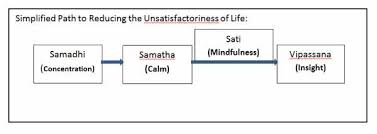
Source: scienceandnonduality.com
The findings suggest that the essence of Vipassana lies in cultivating continuous awareness of the present moment. Practitioners are encouraged to observe bodily sensations, thoughts, emotions, and mental states precisely as they arise and pass away, without attachment, aversion, or judgment. By maintaining awareness of the natural breath (Ānāpāna) and developing equanimity, individuals gradually weaken habitual patterns of mental reactivity and gain insight into the impermanent nature of all conditioned phenomena. This process transforms perception from conditioned responses to conscious understanding, fostering greater emotional balance, self-awareness, and wisdom.
CONCLUSION
The present study concludes that Vipassana meditation provides a profound experiential framework for understanding the nature of consciousness and cultivating equanimity. Unlike conceptual or intellectual approaches, Vipassana emphasizes the direct observation of phenomena as they arise in the present moment. The practice is grounded in the observation of the ultimate realities (paramattha dhamma)—consciousness (citta), mental factors (cetasika), and material phenomena (rūpa)—which can only be comprehended through mindful experience rather than theoretical knowledge. In accordance with the Buddhist principle of dependent origination (paṭicca-samuppāda), consciousness emerges in dependence upon sensory contact and mental processes, highlighting the interdependent nature of human experience rather than the primacy of any single causal factor.
The study further concludes that consciousness cannot be fully understood solely through philosophical speculation or scientific inquiry; rather, it requires direct experiential investigation through disciplined meditative practice. Vipassana offers a systematic path for developing higher consciousness by integrating mindfulness, concentration, and insight. Through sustained practice, individuals learn to perceive reality as it truly is, thereby enhancing psychological well-being, emotional resilience, and inner harmony. Consequently, Vipassana remains not only a contemplative practice but also a valuable interdisciplinary approach for advancing contemporary research on consciousness, mindfulness, and human flourishing.
Certainly. Based on the conclusion of your study, the Future Scope should identify potential directions for further theoretical and empirical research rather than making unsupported claims. Below is a scholarly version suitable for a Scopus-indexed journal.
FUTURE SCOPE OF THE STUDY
The present research study provides a conceptual understanding of the relationship between Vipassana meditation, consciousness, and equanimity from a Buddhist philosophical perspective. First, empirical studies employing quantitative, qualitative, or mixed-method research designs may be undertaken to examine the effects of long-term Vipassana practice on consciousness, emotional regulation, cognitive functioning, psychological well-being, and quality of life across diverse populations.
Second, interdisciplinary research integrating Buddhist philosophy with psychology, neuroscience, cognitive science, and behavioural studies could provide a deeper understanding of the mechanisms through which Vipassana influences perception, attention, self-awareness, and consciousness. Advances in neuroimaging and psychophysiological assessment may further contribute to investigating the neural correlates of meditative states and equanimity.
Third, comparative studies may explore the similarities and differences between Vipassana and other contemplative traditions, such as Zen meditation, mindfulness-based interventions, Transcendental Meditation, and Yoga, to identify their distinctive contributions to mental health and human development.
Future research may also examine the practical application of Vipassana in educational institutions, healthcare settings, workplaces, correctional institutions, and community development programmes to evaluate its potential for promoting emotional resilience, ethical decision-making, stress management, and interpersonal well-being.
Finally, longitudinal and cross-cultural studies are recommended to investigate how sustained Vipassana practice influences consciousness, behavioural transformation, and overall well-being over time. Such investigations would strengthen the evidence base for Vipassana as a contemplative practice and contribute to the growing interdisciplinary discourse on consciousness, mindfulness, and human flourishing.